Showing posts with label Classical Greece and Rome. Show all posts

Sunday, February 21, 2016

Theater "Tickets"

THEATER TOKENS

Tuesday, August 19, 2014

READING ATHENS

Acropolis, Athens at Night (source)

The layout of classical Athens can tell us much about the city. What it valued. What it elevated.

The Acropolis (which means "upper city" in Greek) held the temple for Athena, the protectress of Athens, long before Pericles began his building program. An older Parthenon was destroyed during Persian invasions in 480BC -- right in the heart of the city. So Pericles' coordination of the construction of the Parthenon, the Propylaia, the Erechtheion and the temple of Athena Nike was a demonstration of the power his city held after the defeat of the Persians -- as well as an offering to Athena.

A modern map of the classical city can help us see its shape:

http://plato-dialogues.org/tools/athensim.htm
Click on the map to go to explore the locations at Berhard's great site: 
 http://plato-dialogues.org/tools/athensim.htm


What do you notice about the organization of the polis? What can you "read" about the society from the map? Where is the theater and what is it near?

What is speculation and what is more certain?


Bernard's Key:
Academy
Gymnasium (palæstra) in the northern suburbs of Athens located in a park along the bank of the Cephisius dedicated to the hero Academus. It is in a grove next to that gymnasium that Plato established his school, that took the name "Academy" from it. But before that time, Socrates probably frequented the place, like many palæstræ in Athens, as can be induced from a mention of Plato at Lysis, 203a.
Acropolis
Name, meaning in Greek "higher city", given by the Athenians to the sacred rock in the center of Athens. Initially, the Acropolis was the city itself (Thucydides, II, 15, 3) and the center of public life, but when the city grew and democracy replaced kingship, public life move to the Agora and Pnyx and the Acropolis was restricted to a mostly religious role.
Agora
That part of Athens which was both the market-place and the center of public life in the time of Socrates and Plato. The Greek word "agora" comes from the verb "ageirein meaning "to gather" and designated initially the assembly of the whole people, as opposed to the council of chiefs (boulè). From there, it came to designate the location of that assembly and what happened on this location, hence its later meaning of "market-place". This is the place where Socrates probably spent most of his life, talking with whomever he chance met in the kinds of discussions Plato's dialogues so vividly depict.
Areopagus
Name of a hill of Athens dedicated to Ares (the name in Greek means "hill of Ares") on which met an assembly of elders which took its name. In the time of Socrates and Plato, the Areopagus had been deprived of most of its power after the reforms of of Ephialtes, around 462 B. C. (for more on the Areopagus, see the section on the history of Athens' institutions).
Ceramicus
Name of a public square and a suburb of Athens that owed its name to the fact that it was the potter's district (the Greek word for potter is "kerameus", from the word "keramos" meaning "clay"). The Ceramicus was also the place of burial for soldier dead in wars.
Coele
Attic deme.
Collytus
Attic deme.
Dipylon
A Greek word meaning "double gated", used as a name for the Thriasian Gate, on the northwest of Athens, leading toward the deme Thria and Eleusis.
Eleusis
Attic deme and location of famous mystery cults to Demeter ; see entry on that location
Long Walls
System of defense of Athens linking the city itself to its harbor in Piræus by two parallel walls, in order to protect the communication between the city and the sea against potential ennemies, that is, the link of the city with its food supply and naval forces. The Long Walls were built between 459 and 457 B. C. at the instigation of Pericles. Another wall further east was linking Athens to another one of its harbors, Phaleron.
Lyceum
A gymnasium (palæstra) in the eastern suburbs of Athens, named after the nearby temple to Apollo Lycean (from the Greek name "lukos", meaning "wolf", an animal dedicated to Apollo). The Lyceum seems to have been a favorite palæstra of Socrates , if we are to judge by the many mentions of it in Plato's dialogues : the Lysis takes place after Socrates is stopped while on his way from the Academy to the Lyceum (Lysis, 203a) ; in the Euthyphro, Euthyphro greets Socrates by refering to his habit of haunting the Lyceum (Euthyphro, 2a) ; at the end of the Symposium, Socrates is said to have left Agathon's house in the early morning, leaving everybody else drunk and sleeping, to go strait to the Lyceum (Symposium, 223d) ; and the discussion of Socrates with the sophists Euthydemus and Dionysodorus retold in the Euthydemus takes place in the Lyceum (Euthydemus, 271a). It is near that gymnasium that Aristotle established his school, which, for that reason, became known as the Lyceum.
Marathon
Attic deme and location of a famous victory of Athens over the Persians ; see entry on that location
Melite
Attic deme ; see entry on that location
Odeum of Pericles
A public building in Athens built by Pericles in 445 B. C. and initially dedicated to musical performances (the name "Odeum" comes from the Greek word "ôdè" meaning "song"). It hosted musical contests during the yearly festival of the Panathenæa. It was later used also for various other purposes, serving as a tribunal, a meeting room for the assembly and more.
Olympeion
The temple of Olympian Zeus.
Panathenaic Way
The road leading from the Dipylon to the Acropolis through the Agora, that owed its name to the fact that it was the road followed by the solemn procession (pompè) that constituted the high point of the festival of the Panathenæa, in which a new dress (peplos) was brought to the goddess in her temple of the Parthenon (see Plato's Euthyphro, 2c for a reference to this procession, that also inspired Phidias for the famous frieze of the Parthenon). The Panathenæa, celebrated in honor of Athena each year in the summer (during the month of hecatombæon, that is rouhgly July, the first month of the Athenian calendar), with a more solemn festival every four years (the "Great Panathenæa"), was one of the most important festivals of Athens. It was said to have been instituted by Erichthonius or Theseus at the time when he gathered all Attic tribes (the so-called synoecism) in one "city" and was a memorial of the Athenians' autochtony, their coming from the soil of Attica itself, as was the case with Erichthonius whose birthday was celebrated druing the festival. The Great Panathenæa included sports events and musical contests (Plato's Ion is supposed to take place when the raphsode Ion comes to Athens to compete in one such contest : see Ion, 530b) and were the occasion of a large gathering in Athens of people from all parts of Greece, especially from Athens' colonies. It is during one of these festivals of the Great Panathenæa that Parmenides and Zeno were supposed to have come to Athens and to have had with Socrates the discussion reported in Plato's Parmenide (Parmenides, 127a) and during another one that the discussions reported in Plato's Timæus and Critias are said to have been held (Timæus, 21a and 26e).
Parthenon
See commentary on the map of Acropolis for more on the Parthenon.
Phaleron
Harbour of Athens ; see entry on that location
Piræus
Main harbour of Athens ; see entry on that location
Pnyx
The hill of Pnyx was the location where formal assemblies of the people (the ecclesia) were held.
Sacred Gate
The gate northwest of Athens, next to the Dipylon, so called because it was through it that the Sacred Way leading to Eleusis was leaving the city.
Sacred Way
The road leading from Athens to Eleusis and further to Delphi. It was followed, during the celebration of the Great Mysteries of Eleusis, by the solemn procession leading officials and faithfuls from the Eleusinion, the temple of Demeter at the foot of the Acropolis, to the Telesterion, her temple in Eleusis.
Salamis
Island facing Piraeus in the Saronic Gulf ; see entry on that location
Sunium
Cape at the southern tip of Attica ; see entry on that location
Theater of Dionysus
The theater dedicated to Dionysus, at the southern foot of the hill of Acropolis, where dramatic contests were held during the festival of the Great Dionysia. It started, toward the middle of the VI century B. C., when the cult of Dionysus was introduced in Athens and a wooden statue (xoanon) of the god was brought from Eleutheræ and placed in a temple built on the sacred ground (temenos) consecrated to the god, as a simple round square near that temple that was used during the festival in honor of the god for the ritual dithyrambic dance performed in circle by masked men disguised in he-goats while the crowd was watching from the slopes of the hill. It evolved along with the evolution of the Dionysia that were the matrix from which comedy and tragedy were born in the Vth century B. C. Tiers and a stage, both initially made of wood, were added, probably soon after the Persian Wars, at a time when the festival included full blown theatrical performances, and it is not until 330 B. C. (that is, after Plato's death) that the wooden seats were replaced by stony tiers as we know them today. It is in this theater (probably the first theater in the world) that the masterpieces of Æschylus, Sophocles, Euripides and Aristophanes were performed for the first time.
Theseion
Temple dedicated to Theseus that was an asylum for slaves. The temple now called the Theseion, on a hill west of the Agora, was in fact a temple to Hephæstus, or Hephæstion. The actual location of the Theseion is not known."

This page is copied from Suzanne Bernard's "Plato and his dialogues" (Aug. 14, 2014):
Plato and his dialogues : Home - Biography - Works and links to them - History of interpretation - New hypotheses - Map of dialogues : table version or non tabular version. Tools : Index of persons and locations - Detailed and synoptic chronologies - Maps of Ancient Greek World. Site information : About the author.
First published December 13, 1998 - Last updated September 23, 2000
© 1998 Bernard SUZANNE
Quotations from theses pages are authorized provided they mention the author's name and source of quotation (including date of last update). 

THE PANATHENAIA & A CALENDAR BASED ON FESTIVALS

Athena on a Panathenic amphora, or ceramic vase, which would have been filled with oil and given as a prize at the games -- which were held "around 28th day of Hekatombion, the first month in the Athenian calendar (roughly July)." (National Archaeological Museum of Athens).

What were the major communal events in Athens? 

When were they held and who attended? 

What did they do at these events, aside from, and including, public performance?


GREEK CALENDAR

"There was no single Greek calendar. Almost every Greek community had a calendar of its own, differing from others in the names of the months and the date of the New Year. All were, at least originally, lunar. The months were named after festivals held or deities specially honoured in them. Dios and Artemisios, Macedonian months, were named after Zeus and Artemis; Anthesterion at Athens from the festival Anthesteria. Such month names are found in Hesiod.

The Athenian calendar is best known. The year began, in theory, with the appearance of the first new moon after the summer solstice, and the months were Hekatombaion, Metageitnion, Boedromion, Pyanopsion, Maimakterion, Posideon, Gamelion, Anthesterion, Elaphebolion, Mounichion, Thar‐gelion, and Skirophorion.  from"The Oxford Dictionary of the Classical World"


MONTHS OF THE ATHENIAN FESTIVAL CALENDAR

  1. Hekatombion (thought to have begun with the first new moon after the summer solstice) (Kronia in honor of Cronus and Rhea; Synoikia in honor of Athena(?) and Eirene; Panathenaia in honor of Athena)
  2. Metageitnion (Heracleia in honor of Heracles; Eleutheria in honor of Zeus)
  3. Boedromion (Gemesia/Nemesia/Nekysia in honor of Gaia; Marathon celebration in honor of Artemis; Boedromia in honor of Apollo; Charisteria perhaps in honor of Athena; Eleusinia in honor of Demeter and Persephone; Asklepeia, in honor of Asclepius)
  4. Pyanepsion (Pyanopsia in honor of Apollo; Oschophoria in honor of Apollo; Theseia; Thesmophoria in honor of Demeter and Persephone; Apatouria in honor of Zeus Phratrios and Athena; Chalkeia in honor of Athena and Hephaestus)
  5. Maimakterion
  6. Poseidon (Country Dionysia in honor of Dionysus; Haloia)
  7. Gamelion (Epilinaia in honor of Dionysus; Theogamia in honor of Zeus and Hera)
  8. Anthesterion (Anthisteria in honor of Dionysus; Lesser Mysteries in honor of Demeter, Persephone, and Dionysus; Diaisia in honor of Zeus Meilichios)
  9. Elaphebolion (City Dionysia in honor of Dionysus; Pandia in honor of Zeus)
  10. Munychion (Delphinia in honor of Apollo; Mounichia in honor of Artemis; Olympieia in honor of Zeus;)
  11. Thargelion (Thargelia in honor of Apollo; Bendideia in honor of Artemis Bendis; Kallynteria in honor of Athena; Plynteria in honor of Athena)
  12. Skirophorion (Skira/Skiraphoria in honor of Athena; Dipolia/Disoteria in honor of Zeus Polieus)
From: http://ancienthistory.about.com/od/greeceastronomy/g/AthenianMonths.htm (Aug. 14, 2014)
Wikipedia has a page on the various festivals: http://en.wikipedia.org/wiki/Athenian_festivals


PANATHENAIA

The most important festival each year in Athens was the Panathenaia. Held in honor of the protecting goddess of the city, this festival included the Panathena games -- not to be confused with the more wide-reaching Panhellenic Games (the Olympic games honorong Zeus, the Pythian games for Apollo, the Nemean games for Zeus, and the Isthmian games for Poseidon). At Athena's festival, the victors were given olive oil; at the others listed above, an olive wreath, laurel wreath, wild celery & pine wreaths.

Amid the processions, feasts, athletic & equestrian contests, boat races, sacrifices and hymns to Athena (among other activities) there was a Musical Contest and the performance of the Pyrrhic dance.

Musical Contest, recitations of Homeric poems and, "in later times other poets (e. g. Choerilus of Samos, fl. 420 B.C.) obtained the privilege of being recited at the Panathenaea (Suidas, s. v. Choirilos). The musical contest proper was introduced by Pericles, who built the new Odeum for the purpose (Plut. Pericl. 13). Previously the recitations of the rhapsodes were in the old unroofed Odeum." (http://www.theoi.com/Festival/Panathenaia.html, Aug. 14, 2014)

"The Pyrrhic dance, performed at both the Greater and Lesser Panathenaea (Lys. Accept. Mun. Def. § § 1, 4). With the Euandria and the Lampadedromia it belonged to the more strictly religious part of the festival (cf. Aristoph. Nub. 988 and Schol.). Athena was said to have danced the Pyrrhic dance after her victory over the Giants (Dionys. Hal. vii. 72). As belonging to the religious part of the festival, the prize was an ox for sacrifice, and bore the special title of nikêtêrion (cf. Xen. Cyr. viii. 3, 33, where the ox alone is called nikêtêrion, not the goblets: also Mommsen, 163; Rangabé, ii. p. 671). There were Pyrrhic dancers of all three ages--paides, ageneioi, and andres. A relief published by Beulé (L'Acropole d'Athènes, ii., last plate but one) presents eight armed youths performing the Pyrrhic dance. A full body of Pyrrhicists would then be twenty-four, the number of a comic chorus. They wear a light helmet, carry a shield on their left arms, but are otherwise naked. How the victory was gained in the Pyrrhic dance and the Euandria is not stated; probably by decision of a judge. The. figure on the left of the relief may be perhaps. the judge." (http://www.theoi.com/Festival/Panathenaia.html, Aug. 14, 2014)


The most important festivals for theater were the City Dionysia and the festival of Lenaia.

But another festival to read about is the Thesmophoria, one of the festivals exclusively for women.


THE GREAT DIONYSIA

AND THE LESSER LENEIA

Dionysus. Closeup of a Kleophrades painted vase: 500-490 BC

In late Elaphêboliôn (which we call March), to coincide with the fermentation of the new wine, was the City Dionysia or the Great Dionysia.

How did the festival begin?

There are many legends surrounding the beginning of this festival.

Some are extreme: 
"According to tradition, the festival was established after Eleutherae, a town on the border between Attica and Boeotia, had chosen to become part of Attica. The Eleuthereans brought a statue of Dionysus to Athens, which was initially rejected by the Athenians. Dionysus then punished the Athenians with a plague affecting the male genitalia, which was cured when the Athenians accepted the cult of Dionysus. This was recalled each year by a procession of citizens carrying phalloi." (Wikipedia, City Dionysia, Aug. 14, 2014)

 Some are less so:
"When Pisistratus became tyrant of Athens in 547 BC it marked a change of direction for the city-state and the surrounding land of Attica, which despite its large size and power was overshadowed by many of the other city-states of Greece. During the long period of his rule, Pisistratus sought to correct this. He began by constructing new public buildings, such as a 'fountain house' to improve the city's water supply, and new temples on the Acropolis. Eager to glorify the city, he introduced major new festivals, including the Panathenaic Festival, a midsummer procession and sports event dedicated to Athene, and the City Dionysia, the first known drama competitions." (Pisistratus Rules as Tyrant & Reforms the Economy at http://www.pbs.org/empires/thegreeks/background/6.html) The festival of tragedies was believed to have been founded in 534 BC, which Thespis is said to have won.

Regardless, the City Dionysia was re-worked around 508 to its final form:
"Around 508 Athenian democracy was created and, in order to break up the family loyalties which had been at the root of past rivalries, all the inhabitants of Attica were divided into ten tribes. It may have been out of the desire to stimulate loyalty to the recently created tribes that about this time a new contest -- for dithyrambic performance -- was inaugurated at the City Dionysia. Each tribe, in competition with the other nine, presented two dithyrambs each year, one for men and one for boys. Around 501 reorganization of the City Dionysia added a contest for satyr plays. After this time, each dramatist was required to present three tragedies and a satyr play each time he entered the competition." (Brockett, 17)

WHAT WAS THE SCHEDULE?

DAY 1 
- PROAGON: The poets stood with actors (unmasked) and announced the subject of his 3 plays.
- "BRINGING IN": The wooden image of Dionysus was taken to the edge of the city, sacrifices were made, and then the image was brought back into the city on a ship-chariot in a torch-light procession. The priests of Dionysus would then have a private ceremony when they'd sacrifice a he-goat (tragos).
- PROCESSION: Political leaders proceeded with the arkhon or chief of the festival. One man carried in the sacred fire, others carried phallic symbols (fertility ritual), and others carried wine, food, etc. There were choral performances along the way. Then a bull would be sacrificed to Dionysus, and crowd would celebrate Dionysus by feasting on beef and drinking his wine. 
- COMOS: The reveling would continue with men playing reed-pipes and harps and singing and dancing around the city.

DAY 2-5
- 5 comedies
- 9 tragedies (3 by each writer)
- 3 satyr plays
While they watched the plays, wine was poured and food was shared or sold.
At the end of the festival, the 10 judges (chosen by lots) announced the winner and an ivy-crown was placed on his head.
Then, each chorus leader threw a banquet for his chorus.


Who ran the festival?

The arkhon or chief supervised the procession and contests. But the choregi or chorus leaders were, like producers, in charge of the management of the shows. The writer would serve as director/choreographer (and often actor).

Who performed in the shows?

Chorus members were young men -- chosen because they were in top shape and coordinated. They practiced for an entire year and were revered as athletes.

THEATER OF DIONYSUS

ON THE SLOPE OF THE ACROPOLIS IN ATHENS


The Theater of Dionysus
What we see here and call the remains of the "Theater of Dionysus" are actually the ruins of a Roman site built on top of the Greek theater. While we know that there was a theater on the site when Pericles began building the Odeon (see page) next door in the 440s BC, we don't know much about either the original theater or the changes made under Pericles.

There is much scholarly debate about the shape of the original orchestra -- if it was round or rectangular during the great age of classical theater. "The original performance space (orchestra) was, however, considerably larger than this surviving semi-circle, which dates from Roman times" (Brown, 15).


See this page for more about the theater and its parts.

See this link for more about the Great Dionysia.

THE THEATRON

The major parts of the Greek theater are labeled above. Where the altar was or what it was used for is debated -- I doubt it was in the center of the orchestra. But it is important to remember the role of Dionysus in the theater, as the Greek performances were part of their religious observances (despite the bawdy content of the comedies and satyr plays!). The central seat in the front row may have been reserved for the priest of Dionysus.

The whole space was known as the theatron or "seeing place" (note the emphasis on sight). Between 10,000 and 17,000 spectators would sit on the hill around the orchestra on wooden benches (the stone seating evolved around 338 BC). Athens had about 200,000 citizens, and they and all foreign diplomats, allies and visitors to Athens could purchase tickets. Slaves probably could not. Women, debatable. But we do have record that Pericles set aside 450 for poor Athenian citizens.

The orchestra, which translates to "dance-space", was where the choruses danced and sang. The dithyrambic contests (10 choruses of 50 men and 10 choruses of 50 boys. . . that's 1000 performers!) existed long before theater, and Aristotle asserts theater grew out of them. Because theaters were built based on natural geography, the orchestra space was perhaps varied in shape. There is even debate about the Theater of Dionysus, and if it had a round or rectangular orchestra. 

The skene or "scene" house was probably made out of wood and may have started as a sort of platform built for each year's performances. The plays tell us that the skene needed at least one door opening onto an acting area and that there was an upper acting area (for gods and such). We know little about scenery, but we do know that they did at times have painted sets. "Aristotle (writing in the late fourth century) credits Sophocles with introducing the decoration of the skene, while Vitruvius (first century BC) states that it originated in the time of Aeschylus" (Brockett, 33).

When the ekkylema (devise for revealing tableau -- like scenes of bodies killed offstage) and mechane (mechanism or crane for suspending gods and such. . . as echoed in the deus ex machina or "god from the machine") emerged is unclear.

Tragoidia was an Athenian art form. But few people who use the word tragedy today consider that the Greek word meant "goat song." "When Dionysos first appeared to the daughters of Eleuther, he was dressed in a black goat-skin (melanaigis), but they rejected him, and he therefore made them mad. To be cured, they had to worship him as Melanaigis, lord of the dead, which is why he was offered tragedies (trag-ôidia = goat-song) at this festival." (Bruce MacLennan, http://web.eecs.utk.edu/~mclennan/Classes/US210/City-Dionysia.html)


Random fact:
"Violence in the theater was punishable by death." But you could be noisy and yell at the actors. . .  (Brockett, 35)

THEATER AT DELPHI

THE NAVEL OF THE EARTH


At the sanctuary of Apollo at Delphi -- where Pythia, the Delphic oracle, would speak his prophecies -- was another theater for Dionysus.

As strange as it seems, Dionysus was also worshiped at Delphi.

Each winter, when Apollo would head off to live with the Hyperboreans, Dionysus would take his place at Delphi. Various nocturnal festivities and rites held in honor of Dionysus on Mount Parnassus, towering above Delphi. 


This was the home of the Pythian or Delphic Games -- one of the four Panhellenic Games.  

Held every four years, they honored the god of light, the sun, prophecy, healing, plague, music, dance, and poetry with. . . music and dance. . . and maybe some poetry.


*note: there is a stone at Delphi which is said to be the stone that was fed to Kronos in the place of Zeus. . . check it out if you ever visit.

THEATER OF EPIDAURUS


FAMOUS FOR ITS ACOUSTICS -- AND ITS BEAUTY

Circular Orchestra
Apollo's son, Asclepius, was said to have been born in Epidaurus. Asclepius was revered in the Greek world as a healer, and thus, Epidaurus became the "most celebrated healing center in the Classical world, the place where ill people went in the hope of being cured. To find out the right cure for their ailments, they spent a night in the enkoimeteria, a big sleeping hall. In their dreams, the god himself would advise them what they had to do to regain their health." (source)

The theater was built, in part, as a place to entertain these travelers, as well as the priests and rulers and citizens of the region.


Audience Position


In part due to its extraordinary acoustics, the theater is still in use today.


This image is of a comedy -- and it is very useful to our considerations of how comedy can be played in such a theater.

MASKS & OTHER THEATRICAL CONVENTIONS


Promonos Vase


(in panoramic view)


ODEON OF HERODES ATTICUS

ALSO ON THE SLOPES OF THE ACROPOLIS


Often taken as the famous theater of Dionysus, which is in ruins beside it, the Odeon was originally created for the performance of music.


This space was not, it is believed, built for theater. But it is useful to consider it's architecture as a performance space.

And looking at these images, to consider the role of the natural elements in these performance spaces -- the landscape and geography, the weather, sunlight and shadows, and even bird activity (so essential to the omens in many Greek tales).


BETWEEN TWO WARS: Persian & Peloponnesian

FROM WAR WITHOUT TO WAR WITHIN


The Persian Empire of Darius the Great, 522–486 BC (note the capitol, Persepolis)

"In 499 B.C. the Greek cities of Ionia rebelled against Persian rule. The Persian king, Darius, crushed the revolt and sacked Miletus. Darius invaded Greece to punish Athens for the support of the failed revolt in Ionia. A first Persian invasion failed when the Persian fleet was destroyed in a storm off Mount Athos. A second expedition was decisively beaten by the Athenians and their allies on land at the  Battle of Marathon in 490 BC.

Xerxes, Darius' son and successor, launched a third expedition on a massive scale on land and sea. To avoid the risk of losing the fleet in a storm Xerxes ordered a canal to be dug through the Athos peninsula, a notoriously stormy area. As the army advanced along the Thracian coast Persian diplomats attempted to persuade the Greeks to submit. Many cities and the Greek oracle at Delphi decided to accept Persian terms, but some twenty cities, under the leadership of Sparta, refused to yield.

On August, 480 B.C., 300 Spartans and 5 600 other warriors died at Thermoplylae in a vain attempt to stop the Persian advance. Then, as Xerxes' army marched south, the Athenians were compelled to evacuate the city, which was burned by the Persians.

Yet the Persians had difficulty in supplying their army and Xerxes decided to attack the Greek fleet, which had taken refuge in the Strait of  Salamis near Athens. In the narrow Strait, the superior Persian fleet became disorganised and the Greeks, by skillful maneuvering, were able to win a decisive victory. Xerxes ordered an immediate retreat to prevent his army from being trapped.
A token army was left in Greece but this force was destroyed the following year at the Battle of Plataea. After this defeat the Persians abandoned their expansionist aims and the independence of Greek civilization was secured." From http://www.hyperhistory.com/online_n2/maptext_n2/perswar.html.

After the defeat of the Persians in two major waves of war (and in part because of the boost in reputation these battles brought), Athens' power greatly increased. Whereas Sparta had been the major power in the alliance of Greek city states stretching from what is now Italy to north Africa, after the war the Athenians rose to dominance.

The 200,000 people of Athens, along with their allies, had asserted themselves as a powerful entity against the massive Persian empire (see map above). And they'd established themselves as a relatively unified city or polis -- setting up a democratic system of government that "cut across old tribal and local loyalties and handed over power to the people" (Brown, 13).

Thought the voting citizenry (the demos in the democracy) was made up of only the 40,000 free-born male citizens, the system the Athenians set up preempted the return to power of the "tyrants" (monarchs like Pisistratus, ousted around 510 BC) or the old landed families (oligarchy).  

But with increased power, came increased tension. Athens (a maritime force) and Sparta (with it's land empire) were longtime rivals. While they were all Greeks, they spoke Greek with different dialects, dividing the Ionian Athenians from the Dorians of Sparta and Corinth. And the rise of this new "democracy" didn't sit well with the Spartan oligarchs. 

By 433 B.C. the two cities and their allies were at war. 

By 405 B. C., and the defeat of the Athenian navy at Aegospotamos, Sparta took over. Lysander installed an oligarchy in Athens, and the great age of Athens was past.


Ian Mladjov's Map of Greece During the Peloponnesian War (431-421)

 
KEY NAMES & WORDS:
Pisistratus (ruling 560-510 BC)
   Tragedy contests at the City Dionysia (possibly as early as 534 BC)
Darius of Persia (522-496 BC)
Persian War or Greco-Persian War (499-449 BC)
Pericles (c. 495-430 BC)
   Parthenon (construction started in 447)
   Odeon (construction in 440s)

Peloponnesian War (431-404 BC)
polis = city state

Monday, August 18, 2014

WOMEN & THE THESMOPHORIA

ADD SUBTITLE IN CAPS HERE THEN HIT RETURN
Photo and Body Here

THE SATYR PLAY

ADD SUBTITLE IN CAPS HERE THEN HIT RETURN
Photo and Body Here

ARISTOPHANES, OLD COMEDY, & NEW COMEDY

ADD SUBTITLE IN CAPS HERE THEN HIT RETURN
Photo


Aristophanes' parody of Euripides


Relief with Menander and New Comedy Masks - Princeton Art Museum (CC)


Menander

THE TRAGIC INNOVATIONS OF SOPHOCLES & EURIPIDES


'Death of Pentheus'. Detail from an Attic red-figure clay vase c.480 BC. New York, Market. Christie's © Christies's

AESCHYLUS & THE TRAGIC TRILOGY

ABOUT THE WRITER AND PERFORMER OF THE ORESTEIA TRILOGY

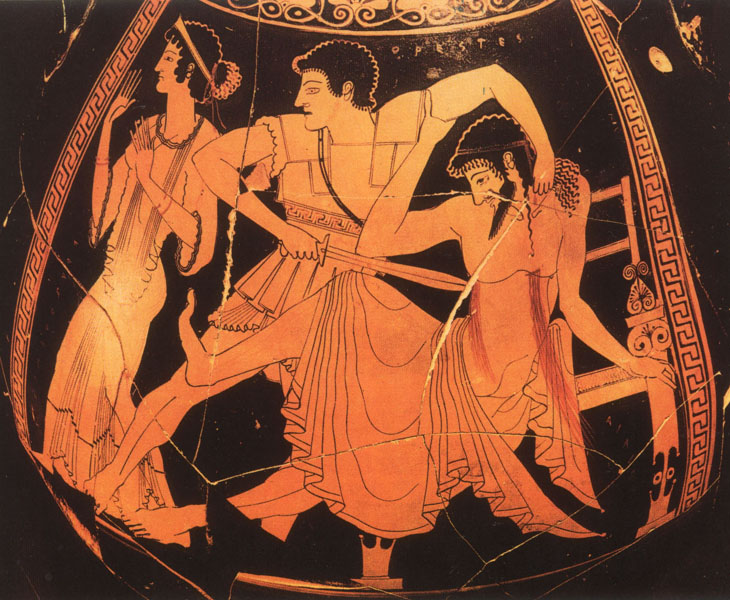
The murder of Aigisthos by Orestes. Detail from Athenian red-figure clay vase, late archaic period. Vienna, Kunsthistorisches Museum

"AESCHYLUS (525-4 B.C. - 456-5 B.C.) surpassed his predecessors and competitors not only as a dramatic poet but also as a theatrical showman. The following excerpts from an ancient biography record his theatrical accomplishments with enthusiasm. We must be aware, however, that the anonymous biographer compiled his account from rather spurious sources:

In his youth Aeschylus began to compose tragedies; in his poetry, in the brilliant mounting of his plays, in the costuming of his actors, and the magnificence of his choruses, he far surpassed his predecessors. As Aristophanes said in The Frogs: “But you, O first of the Greeks , erected noble phrases and embellished tragic trumpery.” 

A contemporary of Pindar, Aeschylus was born 525 years before our era. Of noble birth, he fought in the Battle of Marathon along with his brother, Cynegirus, and later in the Battle of Salamis with his oldest brother, Aminias. He also is supposed to have served in the Battle of Plataea. 

In his writing he always tended toward vigor and loftiness of tone, employing onomatopoeia, epithets, metaphors, and anything that he felt might lend power to his verse. His dramatic structure, however, was quite simple in comparison with that of the younger dramatists since he indulged in fewer peripeties and plot complications. Sublimity meant everything to him. For this reason he concentrated on the grandeur and heroic elevation of his characters, considering it altogether outside the scope of the tragic playwright to portray seemingly ingenious and sententious rogues. Aristophanes made fun of Aeschylus for what he considered the excessive austerity of his characters: in the Niobe, even up to the third part, the mother sits by the tomb of her children restraining her feelings and not uttering a sound; likewise, in the Ransoming of Hector, Achilles completely suppresses his emotions and, save for a reply or two to Hermes in the beginning, has nothing to say. While one finds many different types of artistic treatment in Aeschylus, one looks in vain for those sentiments which draw tears. He uses his dramatic and scenic devices to evoke the stronger passions. 

Aeschylus retired to Sicily, to the court of the tyrant Hieron, because, according to some, he was oppressed by the Athenians and defeated by the young Sophocles at the City Dionysia; according to others, because he was surpassed by Simonides in an elegy on those who fell in the Battle of Marathon. It is said that the elegy of Simonides excelled in subtlety of feeling. 

When, at the performance of The Eumenides, Aeschylus introduced the chorus in wild disorder into the orchestra, he so terrified the crowd that children died and women suffered miscarriage. 

While in Sicily, Aeschylus wrote a tragedy entitled The Aetnaean Women, in which he predicted prosperity for the city of Aetna, which had been recently founded by Hieron. He was greatly honored by the tyrant and later by the inhabitants of Gela, on the southwest coast of Sicily, where, being very old, he died. His death, however, was an accident. An eagle having seized a tortoise and not being master of his prey , dropped it against the rocks to crack the shell. It struck the poet and killed him. He had been warned of his fate by an oracle which declared: “A heavenly missile shall slay thee.” The citizens of Gela buried him with great pomp in a civic monument, inscribing thereon an epitaph of the poet’s own composing: “Here lies Aeschylus of Athens, son of Euphorion, who died in fertile Gela, and whose prowess the long-haired Mede experienced on the celebrated battlefield of Marathon.” His tomb became an object of public veneration, while his tragedies as well as a dramatized version of his life were presented there. Indeed, so beloved was the poet that after his death the Athenians voted that anyone wishing to produce his plays should have a chorus. He lived sixty-nine years during which he wrote seventy tragedies and five satyric plays. He won about thirteen victories, and not a few of them after his death. 

Aeschylus was the first to advance tragedy by means of a more exalted passion. He introduced scenic decorations — paintings, machinery, altars, tombs, trumpets, spirits, Furies — whose splendor delighted the eyes of the audience. He also supplied the actors with sleeved and full-length robes and heightened the buskins to increase their stature. Cleander was the first actor he employed. Later he added Mynniscus of Chalcis as his second. He was also the instigator of the third actor, though Sophocles is given the credit by Dicaearchus of Messene. If we compare the simplicity of Aeschylus’ dramatic compositions with those of his successors, they might be judged jejune and wanting in elaborateness. But if we consider those preceding him, we may well admire our poet for his great talent and inventiveness. Those who hold that Sophocles was a greater tragic poet are right in their opinion, but they should keep in mind that it was more difficult, after Thespis, Phrynichus, and Choerilus, to elevate tragedy to such heights of greatness than for one who wrote after Aeschylus to arrive at the perfection of Sophocles."

Above text from: Nagler, A. M. (2013-04-09). A Source Book in Theatrical History (Kindle Locations 650-660). 

What can we learn from this anonymous biographer? He clearly loved a good story (as much as the Greek historian Herodotus), and his facts are often questioned, but what can we learn from his account even if its facts are disputed?  

We learn from Deipnosaphistai (The Banquet of the Learned), texts compiled by Athenaeus in the Christian Era (200s AD), that Aeschylus "originated many dance-figures and assigned them to members of his choruses" and ""that he acted in his own plays." But whereas Athenaeus takes the comedies of the period as a source of information about the tragedians, our anonymous source above seems to rely on stories about the past. Is one any more credible than the other? Why?
 

Sunday, August 17, 2014

Roman Theaters

ARTIFACTS INTO ART

Roman theater at Aspendos, Turkey

Roman theater of Aman, Jordan


Roman theater at Bosra, Syria


Theater at Ephesus, Turkey (photo by Howard)


Orange, France


ROMAN NAUMACHIA

STAGED NAVAL BATTLES AS ENTERTAINMENT


Domitians Naumachia or Naval Amphitheatre


Julius Caesar held the first known naumachia in Rome in 46 BC as a victory celebration.

Apparently 2000 combatants and 4000 rowers -- all prisioners of war, of course! -- faught on a flooded basin near the Tiber. Wow.


Then Augustus and Claudius picked up the naumachia. Because, at least for Claudius' entertainment-battles, the prisoners had all been condemned to death already, the naumachia were bloody entertainment. Their performers had nothing left to lose.

"In his autobiographical Res Gestae (22.4), Augustus states: I furnished for the people a representation of a naval battle, across the Tiber, where there is now the Grove of the Caesars. This consisted of an artificial lake 1800 feet long and 1200 broad, the grand performance being part of the dedication of the Temple of Mars Ultor in 2 B.C. (source: R.H. Rodgers' translation of 'De Aquaeductu Urbis Romae" of Frontinus (2003) at http://www.romanaqueducts.info/picturedictionary/pd_onderwerpen/naumachia.htm. 
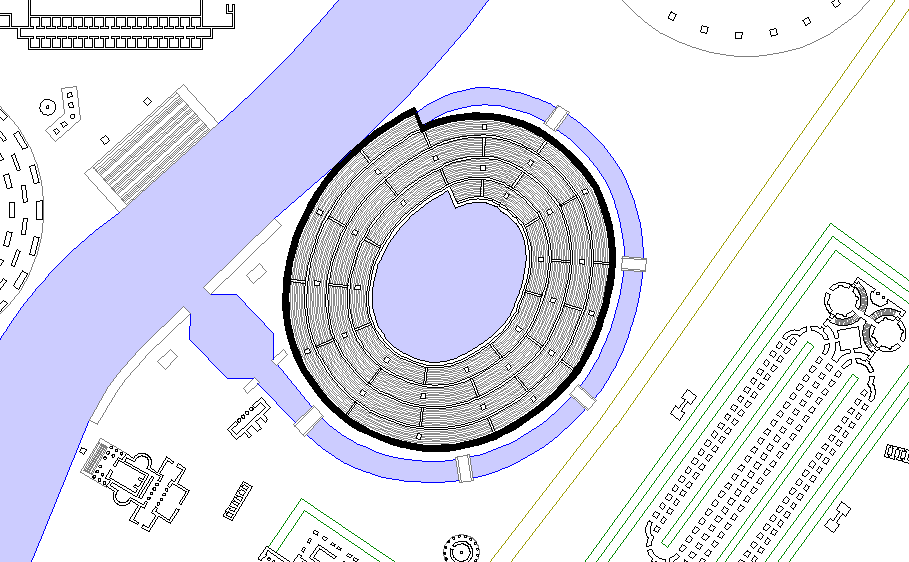

The word naumachia, a phonetic transcription of the Greek word for a naval battle (ναυμαχία / naumakhía), refers to the battles and to the structures created for them.


Read about naumachia construction here: http://www.quondam.com/28/2816.htm


Thursday, August 14, 2014

ARISTOTLE'S POETICS

ADD SUBTITLE IN CAPS HERE THEN HIT RETURN
Photo and

Tells us:
-- There was at least some interest in a lecture on tragedy in the 320's B.C.
-- That theater emerged out of the choral competitions, the choric dithyramb.

Body Here

THESPIS: THE "FIRST" TRAGIC ACTOR

WE'VE BEEN "THESBIANS" EVER SINCE

Fiechter's sketch of possible Theater of Dionysus in the days of Thespis (source).

"Playwright, actor, stage director, and producer" (the division of theatrical labor had not yet emerged), "Thespis is credited with a number of innovations. He is said to have connected the chorus with a plot; he seems to have evolved the protagonist (hypokrités, the “answerer”), destined to face a tragic dilemma and forced to answer the ever-questioning chorus; he discarded the cruder dithyrambic make-up by making use of unpainted linen masks; and, if we care to trust Horace, Thespis travelled about with a company of strolling players on a wagon.

Pisistratus, having seized the castle and power of Athens by a coup d’état in 560 B.C., decided to enlarge the artistic scope of the City Dionysia by including plays in the official program of the festival. He asked Thespis, the Attic peasant-artist, to participate with his troupe. The date was 534 B.C., though this hardly marks the first appearance of Thespis in Athens, as, earlier, he may have participated in the Lenaea Festival.

On one such festive occasion, Solon, the legislator, came to witness one of Thespis’ performances and afterward went to see the artist. Plutarch saved this oldest “backstage” scene from oblivion:

Thespis, at this time, beginning to act tragedies, and the thing, because it was new, taking very much with the multitude, though it was not yet made a matter of competition, Solon, being by nature fond of hearing and learning something new, and now, in his old age, living idly, and enjoying himself, indeed, with music and with wine, went to see Thespis himself, as the ancient custom was, act: and after the play was done, he addressed him, and asked him if he was not ashamed to tell so many lies before such a number of people; and Thespis replying that it was no harm to say or do so in play, Solon vehemently struck his staff against the ground: 'Ah,' said he, 'if we honor and commend such play as this, we shall find it some day in our business.'"

All text above from Nagler, A Source Book in Theatrical History, p. 3-4.

Plutarch was one of Shakespeare's major sources (a name to learn for folks interested in Shakespeare, for sure!), and here he is in his The Lives of Noble Grecians and Romans (translated by John Dryden and Arthur Hugh Clough, p. 115) recounting Solon's visit to the theater. 
AMAZING primary document!! What can we learn from it?
 
Copyright © 2014 Theater  History